Residential Level 2 EV charger installation requires calculating the existing electrical load under the 2023 National Electrical Code (NEC Article 625) before adding a high-draw appliance. Many 1920s Spanish bungalows…
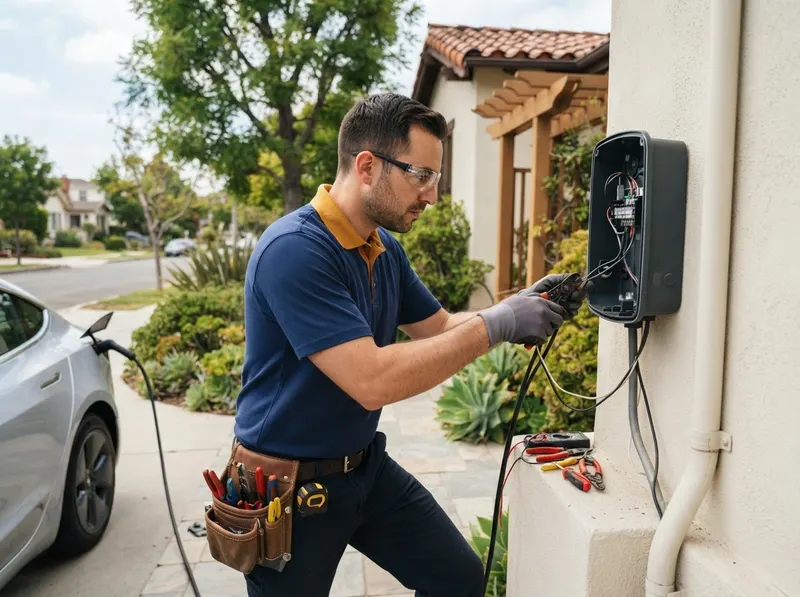
Residential Level 2 EV charger installation requires calculating the existing electrical load under the 2023 National Electrical Code (NEC Article 625) before adding a high-draw appliance. Many 1920s Spanish bungalows in Silver Lake, Mid-City, and Leimert Park still operate on 100-amp main service panels containing Zinsco or Pushmatic breakers. Adding a continuous 48-amp EV load (which requires a 60-amp circuit breaker under the NEC 125 percent continuous-load continuous rating rule) to a 100-amp panel will cause main breaker trips whenever central air conditioning runs simultaneously. In contrast, mid-century homes in Sherman Oaks or newer builds in Brentwood frequently have 200-amp panels that accommodate a 50-amp NEMA 14-50 receptacle or a 48-amp hardwired wall connector without an immediate service upgrade.
Selecting between a 40-amp plug-in station and a 48-amp hardwired station determines charging speed and installation architecture. A plug-in unit utilizes a NEMA 14-50 outlet delivering up to 32 continuous amps (adding roughly 25 to 30 miles of range per hour). This setup demands an internal GFCI breaker inside the main panel, which can occasionally conflict with the charging station's onboard ground-fault monitor. A hardwired 48-amp charger draws 11.5 kilowatts on a 60-amp breaker (adding 35 to 45 miles of range per hour) and does not require an external GFCI breaker, eliminating false tripping. The physical run distance creates the primary price variance: a subpanel mounted adjacent to a garage in Highland Park costs significantly less than running 75 feet of rigid conduit through a finished crawlspace in Los Feliz or across exterior stucco in Venice.
Permitting is managed through the Los Angeles Department of Building and Safety (LADBS). For Los Angeles Department of Water and Power (LADWP) customers, dedicated residential EV charger installations often qualify for the LADWP Charge Up LA! rebate, which offers up to $1,000 for residential charger deployment and dedicated panel upgrades. Installations must adhere to local utility requirements, including proper torque specifications on terminal lugs, listed EMT or schedule 40 PVC conduit, and copper wiring sized appropriately (such as 6 AWG copper for 48-amp charging or 4 AWG for longer exterior runs subject to thermal derating during hot San Fernando Valley summers).
Every job gets a firm, written price after a free on-site visit.
Tell us about your level 2 ev charger installation job in los angeles and we'll send a clear, written quote, usually the same day.
 Bright Electrician